
Breathe with the square.
Box breathing at the app’s own pace: in, hold, out, hold, four seconds each. Try it here — it is the same square.
4
Ready
4.7 · 307 App Store ratings
An anxiety journal and mood diary for panic attacks. Something to breathe with while it happens, a one-minute record after, and the pattern that shows up over the months. No account needed — your records stay on your phone.
Right now
Open the app and there is a shape to follow. Nothing to read, nothing to decide, nothing to set up.
Box breathing at the app’s own pace: in, hold, out, hold, four seconds each. Try it here — it is the same square.
4
Ready
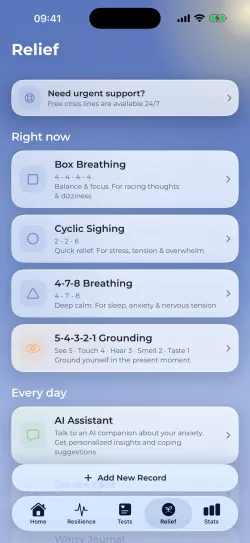
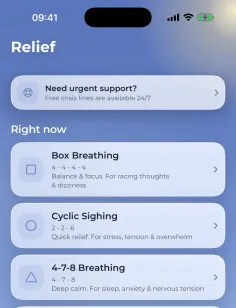
Box breathing, cyclic sighing for a spike, 4-7-8 for 2am, and grounding. A Live Activity keeps leading you from the lock screen. Crisis lines for your country sit at the top.
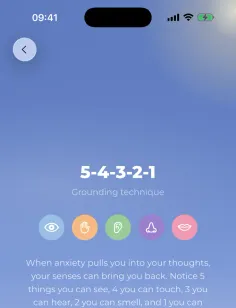
Five things you can see, four you can touch, three you can hear, two you can smell, one you can taste. Your senses pull you back into the room.
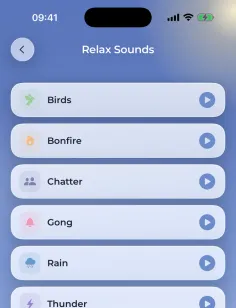
Rain, birds, a bonfire, white noise. Layer them, save a preset, set a timer so it stops after you have fallen asleep.
Every day
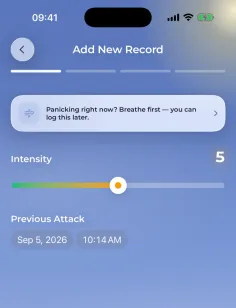
A record takes under a minute, right after — while you still remember what it felt like and what helped.
How strong it was, what your body did, what set it off, what helped. Fourteen symptoms are built in; add your own.
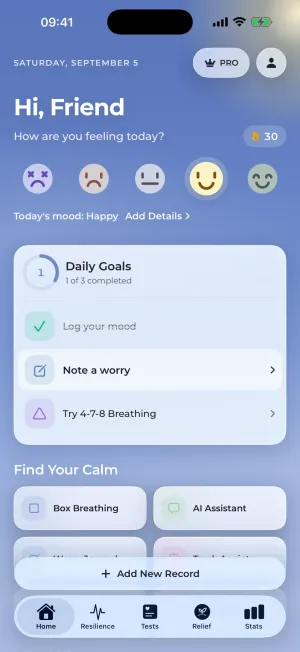
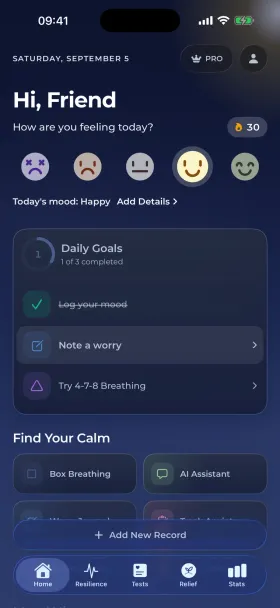
Five faces on the home screen. Tap one and the day is logged. Add details if you want to, or don’t.
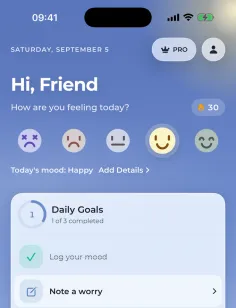
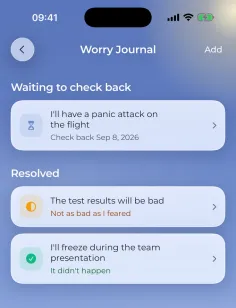
Write the worry down and pick a date to check back. Over time you count how many of your fears never came true.
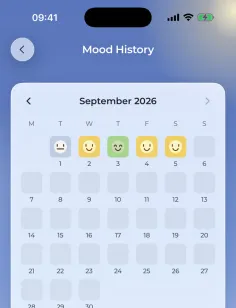
Every day as a face on a calendar, and a mood bar for the balance: how much of the month was actually all right.
Over time
Weeks of small records add up to something you can show a doctor — or just understand about yourself.
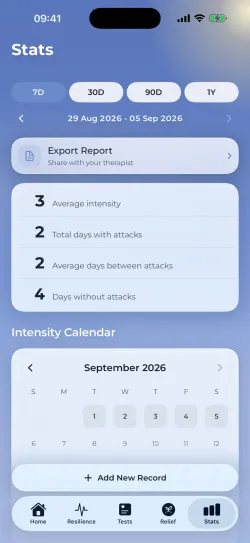
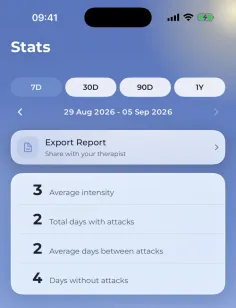
Average intensity, days between attacks, an intensity calendar coloured by how hard each day hit. A week, a month, a year. Export a PDF.
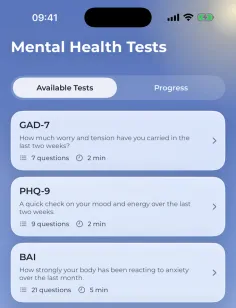
GAD-7, PHQ-9, BAI, K10, DASS-21 and SIAS — the scales clinicians use, scored with their bands and kept as a history.
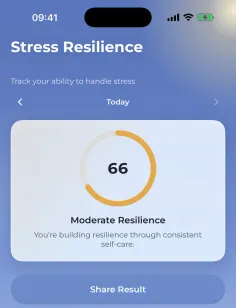
Mood, attacks and — with an Apple Watch — heart rate variability, resting heart rate and sleep, folded into one number for today.
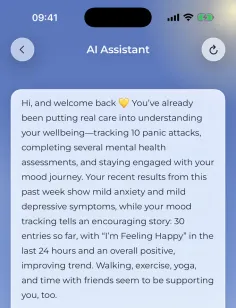
With sharing on, it already knows your recent attacks and moods, so you never have to retell them. It is off by default.
Yours
This is a mental-health record. It is built as if it were yours, because it is.
Nothing to sign up for. Signing in is optional and moves nothing: your records are files on your phone, and deleting the app deletes them.
So a new phone finds your history. It never passes through a server of ours.
Heart rate variability, resting heart rate and sleep are read for the resilience score. The one thing written back is a Mindful Minutes session after breathing.
Record sharing is off until you turn it on, and it can be turned off again mid-conversation.
What it costs
The tracker is not a trial. Everything you need in the moment is free and stays free. Pro is for the analysis afterwards.
Free
$0 forever, no account needed
Pro
Subscription the price is shown in the app, in your currency
Answers
No, and it does not pretend to be. It is a record and a set of tools: the worry journal follows a CBT structure, the assessments are the standard scales, the breathing is breathing. It is useful to bring to a therapist and it does not replace one. If you are in crisis the app puts your country’s helplines one tap away, from the home screen.
On your phone, as files. No sign-in is needed, and no server of ours holds them. A copy is kept in your own iCloud Drive so a new phone finds your history, and deleting the app deletes the rest.
Only what you switch on. With record sharing off it is a plain conversation. With it on, it gets a summary of your recent attacks, moods and test results so you do not have to retell them. You can turn it off in one tap and keep chatting. What you type goes to the AI provider through our relay; the policy page says exactly what.
No. The resilience score is built from your mood and attack history alone and the weighting adjusts automatically. If you do wear one, heart rate variability, resting heart rate and sleep are read from Apple Health and the score gets sharper. The watch app also runs the breathing exercises on your wrist.
Nothing breaks and nothing nags. There are streaks if you want them, but the app is built for the weeks you use it, not the weeks you do not. Pick it up again and the history is still there.
English, German, French, Spanish, Italian, Portuguese, Polish, Czech, Hungarian, Romanian, Swedish, Russian, Ukrainian and Simplified Chinese — the interface, the assessments and the assistant.
Read on
How to keep the record, with or without the app.
Anxiety Tracker · Mood Journal
Not because it hurts less. Because you will know its shape, and you will have it written down.
Free · iOS 17 or later · Android · 14 languages · Made in Ukraine
If you need help right now, here are the numbers.
In the US and Canada, 988 reaches the Suicide & Crisis Lifeline. In the UK and Ireland, Samaritans is 116 123. Anywhere else, call your local emergency number. The app carries the right numbers for your country and reaches them from the home screen in one tap.