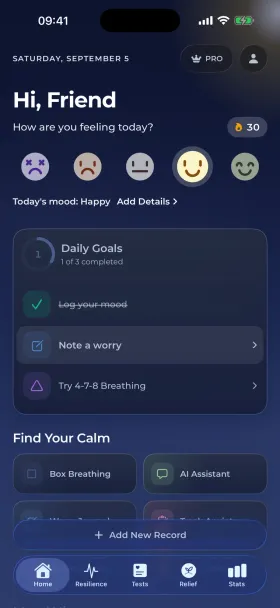
GAD-7, explained.
Seven questions about the last two weeks, a score from zero to twenty-one, and four bands. What it measures, what it does not, and how to use it over time.
What it is.
The GAD-7 is the short anxiety scale most doctors use. Seven statements, each answered for the last two weeks on the same four-point scale: not at all, several days, more than half the days, nearly every day, scored zero to three. The total runs from zero to twenty-one.
It was published in 2006 by Robert Spitzer, Kurt Kroenke, Janet Williams and Bernd Löwe, the group behind the PHQ-9 for depression, and it was built to do two jobs: to flag people who may have generalised anxiety disorder, and to follow how severe it is from one visit to the next. It does both in about two minutes.
It is free to use, in any setting, without a licence. That is one reason it is everywhere: in GP surgeries, in therapy intake forms, in research, and in apps like this one.
The seven questions.
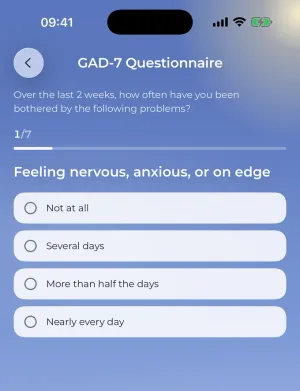
Over the last two weeks, how often have you been bothered by the following problems?
- Feeling nervous, anxious, or on edge
- Not being able to stop or control worrying
- Worrying too much about different things
- Trouble relaxing
- Being so restless that it’s hard to sit still
- Becoming easily annoyed or irritable
- Feeling afraid as if something awful might happen
Notice what is on the list and what is not. Four of the seven are about worry and its control; two are about the body being unable to settle; one is about dread. There is nothing about panic attacks, nothing about avoidance, nothing about sleep. The scale measures the worrying kind of anxiety, and it measures that well.
What the score means.
Add the seven answers. The bands are the ones the authors published:
- 0 to 4: minimal anxiety
- 5 to 9: mild
- 10 to 14: moderate
- 15 to 21: severe
Ten is the number to know. In the original study a score of ten or above identified generalised anxiety disorder with good sensitivity and specificity, and it is the usual point at which a clinician suggests a fuller assessment. It is a threshold for a conversation, not a verdict; plenty of people score above ten in a hard fortnight and below it in the next.
The app scores it into the same four bands and keeps the result, with its date, in a history.
Using it over time.
A single GAD-7 is a snapshot. Its real use is the series. Take it every two weeks, on the same weekday, and keep the scores. Every question asks about the last fortnight, so a fortnight is the natural spacing; more often and you are scoring the same days twice.
Then read the line, not the points. A drop of about four points is generally taken as a change worth noticing; a single point either way is noise. If you have started something new, a medication, therapy, an exercise habit, the series is how you and your clinician will tell whether it is doing anything.
Answer for the fortnight, not for today. The morning you take it is one day of fourteen; a bad morning should move the score by very little.
The app keeps the history and, when a result is more than two weeks old, suggests taking it again. It does not nag before that.
What to keep beside it.
The GAD-7 does not see panic attacks, and it does not see mood. For those, keep two other records next to it:
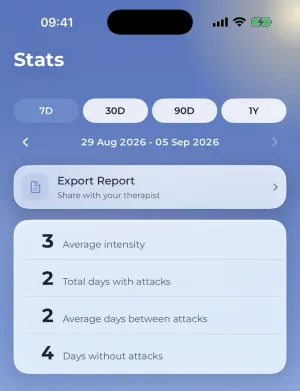
- A panic attack log: when, how strong, how long, what helped. Attacks are events, and a fortnightly scale cannot count them.
- A mood diary: one mark a day. Low mood travels with anxiety often enough that the PHQ-9, the GAD-7’s sibling for depression, is worth taking on the same day.
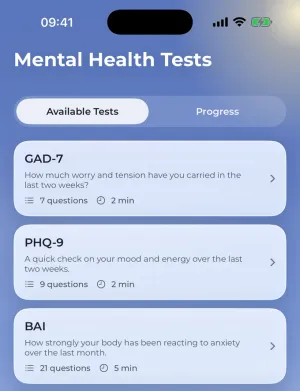
The BAI is the other scale worth knowing: twenty-one questions about the body’s side of anxiety, numb hands, a pounding heart, fear of the worst happening. It maps onto panic far better than the GAD-7 does.
GAD-7, PHQ-9 and BAI are free in Anxiety Tracker and scored with their bands. K10, DASS-21 and SIAS are part of Pro. The attack log, the mood diary and the scales all sit in one place, so the month can be read as one thing.
Answers
Questions people ask.
Is a GAD-7 score a diagnosis?
No. It is a screening and monitoring scale. A score of ten or more is the usual signal that a proper assessment is worth having; the assessment itself is a conversation with a clinician, who will also ask about how long this has been going on and what it costs you day to day.
What counts as a bad score?
The scale does not think in good and bad. It thinks in bands: 0 to 4 minimal, 5 to 9 mild, 10 to 14 moderate, 15 to 21 severe. What matters more than any single number is the direction over a few months.
Does GAD-7 measure panic attacks?
Not directly. It was built for generalised anxiety, the worrying kind. Panic attacks are better captured by a log of the attacks themselves, and by the BAI, which asks about the body. Many people with panic also score on the GAD-7, because the worry about the next attack is exactly what it measures. How to keep a panic attack log
How often should I take it?
Every two weeks is the natural interval, because every question asks about the last two weeks. Taking it more often measures the same fortnight twice. The app suggests a retake when the last result is more than two weeks old.
Is it free?
The scale itself is free to use for anyone; it was developed with a grant from Pfizer and released without a licence fee. In Anxiety Tracker the GAD-7, the PHQ-9 and the BAI are free and kept as a history. K10, DASS-21 and SIAS are part of Pro.