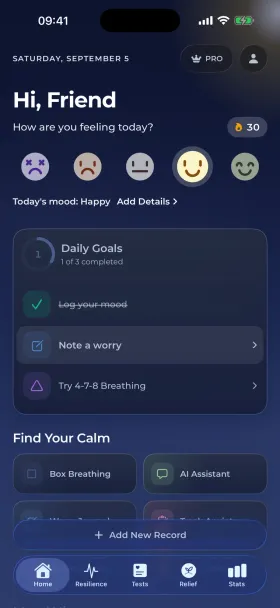
How to keep an anxiety journal.
Not a diary of feelings. A short record of each attack and each worry, kept the same way every time, so that after a month there is something to look at.
Why write it down at all.
Panic attacks are badly remembered. While one is happening the body is busy, and afterwards the mind rounds it up into three sentences: it lasted forever, it came from nowhere, nothing helped. An anxiety journal replaces those three sentences with details written while they were still true.
Two people read it later. One is you, a month on, looking for a shape. The other is a doctor or a therapist, who will ask the same five questions everyone is asked: how often, how strong, how long, what sets it off, and what helps. An honest month of entries answers all five, and answers them better than memory does.
That is the whole job. It is not a place to write about anxiety. It is a place to write down what happened.
What to write after a panic attack.
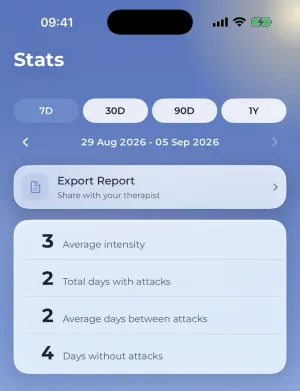
Write it right after, not that evening. The details go first: by night you remember that it was bad, not what it was. One entry should take under a minute, and it should have the same parts every time, so that entries can be compared. The panic attack log guide takes each field in turn.
A one-minute entry
- When it started and roughly how long it lasted. Guess if you have to; a guess made now beats a certainty made later.
- How strong, on a scale from one to ten. Pick fast. The first number is the right one.
- What the body did. Racing heart, chest tightness, shaking, dizziness, numb hands, the feeling of not being quite real. Tick from a fixed list rather than describing it fresh each time; a fixed list is what makes a month countable.
- What was happening just before. Not the cause, just the scene: where you were, who was there, how you had slept, coffee, an argument, a train.
- What helped, even a little. Breathing, leaving the room, cold water, someone’s voice, waiting.
- Medication, if you took any, and when.
In Anxiety Tracker that is one screen: an intensity slider, fourteen built-in symptoms to tap, triggers, what helped, medication, and a note if you want one. The date of the previous attack sits at the top, so the gap between them is something you see rather than something you have to work out.
The worry journal: write the fear, then check it.
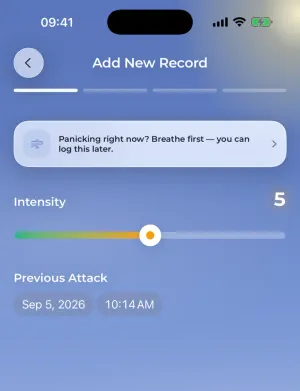
Attacks are the loud part of anxiety. The quiet part is prediction: the meeting will go wrong, the test result will be bad, the flight will be the one. A worry journal is the cognitive-behavioural tool for that, and it has three steps.
- Write the worry as a sentence about the future. “I will faint in the presentation on Thursday.” Not “I am anxious about work.” A prediction can be checked; a feeling cannot.
- Pick the date by which you will know. Thursday evening.
- Come back and record what happened. It didn’t happen. It happened, but not as badly as feared. It happened.
The point is not any single worry. It is the count. After a few months you have a number for how often your predictions came true, and for most people it is a small one. That number does more against the next worry than any amount of reassurance, because you produced it yourself.
The app keeps the tally, and it reminds you on the day you chose to come back and say how it turned out.
What a month of entries shows.
Read the journal once a week, not every day. Look for these, in this order:
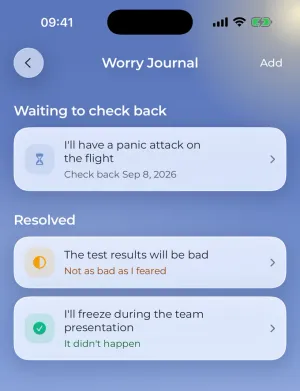
- Days between attacks. The first number that improves, and the one people forget to notice. Three attacks a week to one a fortnight is a large change that feels like nothing from the inside.
- Intensity, over time. Not the worst one. The average, and whether it is drifting.
- Clustering. A time of day. A weekday. The days after short sleep, or after alcohol, or before a period. This is where the scene you wrote down each time pays off.
- Triggers that repeat. Most people have two or three, not twenty.
- What helped, more than once. Whatever appears here is what to reach for next time, and what to practise in between.
The stats screen does this arithmetic: average intensity, days with attacks, the gap between them, and a calendar coloured by how hard each day hit, for a week, a month or a year.
Paper, or an app.
Paper works. If a notebook is what you will actually keep, keep a notebook, and use the six parts above as the headings on every page. What paper does not do is the arithmetic, and it does not carry a fixed symptom list, so entries drift and stop being comparable. It also does not turn into a PDF for a doctor.
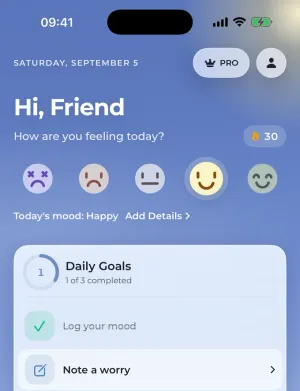
An app should do those things and nothing that makes the record harder to keep. It should not nag. It should not need an account, and it should not send a mental-health record anywhere. Anxiety Tracker needs no account: the records are files on your phone, with a backup in your own iCloud Drive so a new phone finds them, and deleting the app deletes them.
It also does the things a journal cannot do in the moment: box breathing, cyclic sighing, 4-7-8 and 5-4-3-2-1 grounding are on the same home screen as the record, and free.
Taking it to a doctor.
Bring the summary, not the notebook: attacks per month, average intensity, the longest gap, the three most common triggers, and what helped. That is a five-minute conversation instead of a fifteen-minute one, and the rest of the appointment is yours.
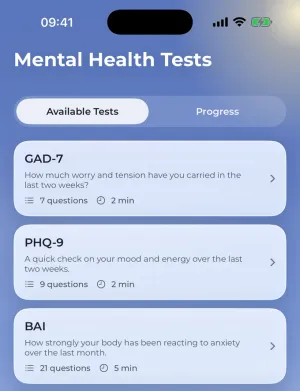
Add a standard scale. The GAD-7 is seven questions about the last two weeks and takes about two minutes; it is scored into bands that clinicians recognise, and taking it every fortnight gives a line rather than a point. The PHQ-9 does the same for low mood, which often travels with panic.
GAD-7, PHQ-9 and BAI are free in the app and kept as a history. The PDF report, with the same numbers laid out for a clinician, is part of Pro.
None of this is treatment. It is a record, and a good one makes treatment easier to get and easier to judge.
Answers
Questions people ask.
How is an anxiety journal different from a mood diary?
An anxiety journal records events: attacks and worries, each with a time, a strength and some detail. A mood diary records one mark a day, whatever happened. They answer different questions and they work best kept together, which is why the app does both. How to keep a mood diary
I do not get panic attacks, just anxiety. Is it still for me?
Yes. Use the worry journal as the main tool and the attack record only for the spikes. A month of worries with their outcomes is the most useful thing a generally anxious person can bring to a first appointment.
How long before it shows anything?
Two or three weeks for the first pattern, usually a trigger or a time of day that repeats. A month for something a doctor can use. Do not read it every day; once a week is enough, and the app’s stats screen does the counting.
Will writing about attacks make me think about them more?
That is what the structure is for. An entry is numbers and a few taps, made once, right after, and then left alone. If you find yourself rewriting the entry at two in the morning, stop there: the record is finished, and the rest is rumination, not journaling.