How to keep a panic attack log.
A log is the numbers: when, how strong, how long, what the body did, what helped. Six fields, filled in the same way every time, and nothing else.
Why a log, and not just a note.
A note says “bad one on the train.” A log says Tuesday, 8:40, seven out of ten, twelve minutes, racing heart and numb hands, three coffees and four hours’ sleep, breathing helped. The first is a memory. The second is data, and data is what a doctor can act on and what a month can be built from.
The difference is not effort. Both take under a minute. The difference is that the log has the same fields every time, so the twelfth entry can be laid beside the first. That is the whole discipline: not writing more, writing the same.
A log also answers the question that panic itself makes unanswerable: is it getting better? From the inside every attack feels like the worst one. The log keeps the actual numbers, and the numbers usually disagree.
The six fields.
- When, and for how long. The start time, and a rough duration. Most attacks peak within ten minutes and are over within half an hour; if yours run longer, that is worth knowing too.
- Intensity, from zero to ten. One number, chosen fast. Do not compare it with the last one; just answer for this one.
- What the body did. Tick from a fixed list. The clinical list has thirteen items: racing heart, sweating, trembling, shortness of breath, a choking feeling, chest pain, nausea, dizziness, chills or hot flushes, numbness or tingling, a sense of unreality, fear of losing control, fear of dying. Ticking beats describing, because ticks can be counted.
- What was going on. The scene, not the explanation. Where, with whom, how you slept, what you drank, what had just happened. Keep the list of possible triggers your own and short.
- What helped. Even a little, even if you are not sure it was that. Over a month the things that keep appearing here are the things that work.
- Medication, if any, and when you took it relative to the start.
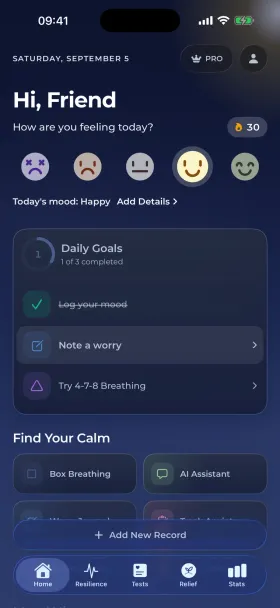
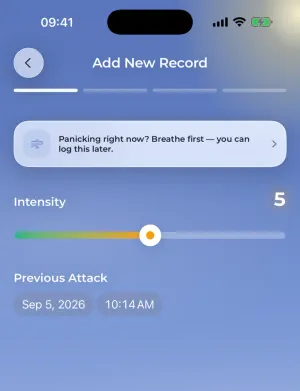
In Anxiety Tracker the record has exactly these parts: a 0–10 intensity slider, fourteen built-in symptoms (the thirteen above plus general anxiety), your own lists of triggers, coping strategies and medications, a duration, and a note. The date and time of the previous attack are shown at the top, so the gap is visible as you log.
Not during. After.
Do not log while it is happening. A log is not a coping strategy, and a phone with a form on it is not what a body in the middle of a surge needs. What it needs is something to do for two minutes: box breathing, four seconds a side; a long slow exhale; five things you can see. Then the log.
The right moment is the ten minutes after, when the details are still sharp and the fear has stepped back far enough for a number. By that evening you will remember that it was bad. By next week you will remember that it was the worst.
The app’s record screen opens with “Panicking right now? Breathe first — you can log this later,” and means it. The breathing runs from the lock screen as a Live Activity, and on the wrist if you have a watch. The record waits.

What the numbers say after a month.
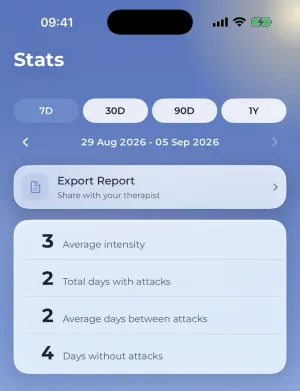
Four numbers, in this order of importance:
- Days between attacks. The gap is the first thing to improve and the last thing people notice. Watch the longest gap of the month; it is the number that grows.
- Days with attacks. Not the count of attacks: a bad day with three is one bad day.
- Average intensity. Not the peak. The average drifts down before the peaks do.
- Duration. Attacks that end sooner are attacks you are getting better at ending.
Then the calendar: a month with each day coloured by how hard it hit. Clusters show up here, a weekday, a time of the month, the days after a short night. And the two columns that make the log worth keeping, triggers that repeat and things that helped more than once.
The stats screen does this for a week, a month or a year, and draws the calendar. Look at it once a week; more often and you are staring at noise.
Handing it to someone.
A GP or a therapist asks the same things at the first appointment: how often, how strong, how long, what sets it off, what helps. A month of the log is the answer to all five, and it moves the conversation past history and into what to do.
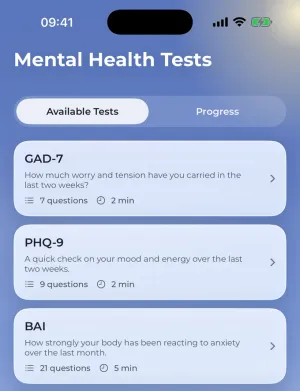
Add one standard scale. The BAI, twenty-one questions, is about the body’s side of anxiety and maps closely onto what a panic log records. The GAD-7, seven questions, covers the worry side. Both are free in the app and scored with the bands clinicians use, and a fortnightly score beside the log is a line rather than a point.
The PDF report, which lays the same numbers out for a clinician, is part of Pro. The log itself, every attack for as long as you use it, is free and stays free.
Answers
Questions people ask.
How many symptoms make it a panic attack?
The clinical definition asks for a sudden surge of fear that peaks within minutes, with four or more of thirteen listed symptoms. For a log it does not matter. Record the episode whether it was four symptoms or two; a “near miss” that you breathed through is exactly the kind of entry that shows what helps.
Panic attack or anxiety attack?
A panic attack is the sudden kind: a surge that peaks in minutes and passes. “Anxiety attack” is not a clinical term, and people use it for a slower build of dread that can last hours. Log both, but log the sudden ones as attacks and the slow ones as a worry or a low day, so the two do not blur.
How is a log different from an anxiety journal?
The log is the numeric part: when, how strong, what the body did, what helped. The journal adds the worries, the check-backs and the reading of the month. The log is what a doctor asks for first; the journal is what you keep for yourself. How to keep an anxiety journal
Should I log while it is happening?
No. Breathe first; the log can wait ten minutes and will be better for it. Anxiety Tracker puts a breathing shortcut at the top of the record screen for exactly this reason, and keeps the record open for later.
What if I forget to log one?
Add it when you remember, with the date and a rough intensity, and skip the details you are not sure of. One missing entry does not spoil a month. Filling it in from imagination does.