How to keep a mood diary.
One mark a day, taken the same way every day. Not an essay. After a month it is a calendar you can read, and a memory you can trust.
Why a mark a day beats remembering.
Ask yourself how the last month was and you will answer with this week. Memory for mood is biased two ways at once: towards the worst days, and towards the most recent one. A bad Tuesday colours the whole of March; a good fortnight disappears behind one hard weekend.
A mood diary is the only fair witness. One mark, made on the day, before the day has been revised. Thirty of them side by side say something no amount of thinking back can say, which is how much of the month was actually all right.
For anyone with panic, mood is the slower signal. Attacks are spikes. Mood is the tide underneath them, and the tide is what tells you a rough week is coming before the spikes do.
How to rate a day.
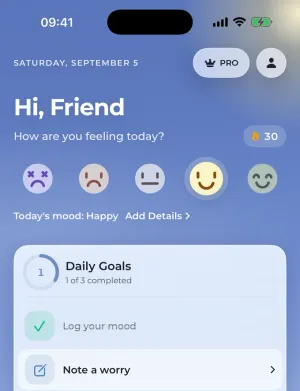
- Five points, not ten. Awful, bad, all right, good, great. Ten points invites deliberation; five is answered in a second, and a second is the right amount of time.
- The same time every day. Evening, when the day is over, or first thing about yesterday. What matters is that the mark is always taken from the same place.
- Pick fast. The first face is the right face. If the day was two days, the evening wins, or make two marks.
- Add a note only when there is something to remember. Most days need nothing. “Slept four hours.” “Argument with M.” “Ran.” That is plenty.
- Tag the things you suspect. Sleep, exercise, alcohol, caffeine, work, people, the days before a period. A tag costs one tap and turns a hunch into something you can check.
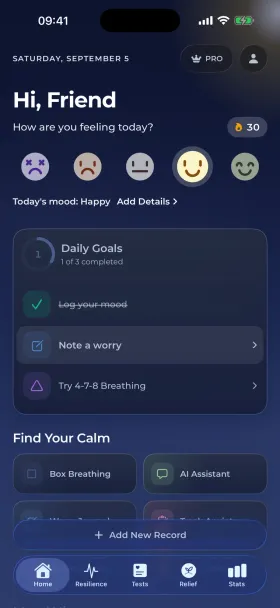
In Anxiety Tracker the five faces are on the home screen, so the whole diary is one tap on the way to anything else. A note and activity tags are there if you want them; your own tags are part of Pro.
Reading the calendar.
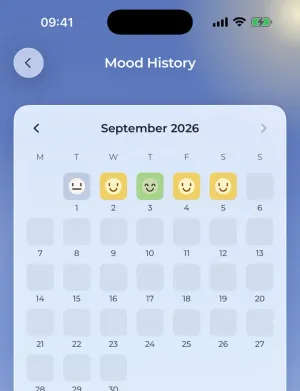
At the end of the month look at the calendar, not the list. Faces on a grid show shape in a way a list never does. Then ask one question. One per month is enough; these are the usual ones:
- Is there a weekday? Sunday evenings and Monday mornings are the common answers. Wednesdays surprise people.
- How long are the runs? Three grey days in a row is a different thing from three grey days scattered across a month, even though the count is the same.
- What happened the day before the grey ones? This is where the tags and the short notes earn their keep.
- How fast do you come back? The gap between a bad day and the next ordinary one is a number that improves with treatment, and almost nobody notices it improving.
The app draws the month as faces on a calendar and adds a mood bar for the balance: how much of the month sat on each side. That bar, month by month, is the plainest progress chart there is.
Mood and panic on the same page.
Kept separately, a mood diary and a panic attack log are two half-answers. Kept together they answer the question people actually have: do the low weeks come first, or do the attacks? For many people it is the low weeks, by a few days, and knowing that turns a low week into a warning rather than a verdict.
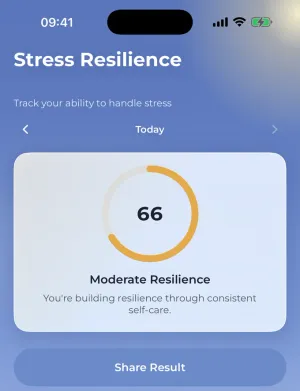
Anxiety Tracker keeps both in one place and folds them into a daily resilience score. Without a watch the score comes from your moods and your attack history alone. With an Apple Watch, heart rate variability, resting heart rate and sleep are read from Apple Health and the score gets sharper. Either way it is one number for today, and a line for the month.
When a diary is not enough: the standard scales.
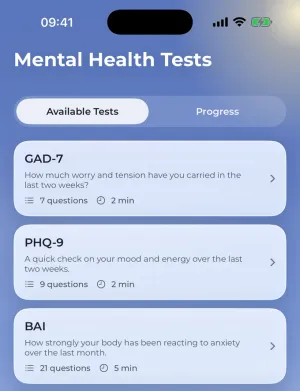
A mood diary is your instrument. A clinician has their own, and it helps to speak their language. The PHQ-9 is nine questions about the last two weeks, scored into bands from minimal to severe, and it is what most doctors use for low mood. The GAD-7 is its counterpart for anxiety, seven questions, about two minutes.
Take them every fortnight, on the same weekday, and keep the scores. A diary tells you what the month felt like; the scale tells a doctor where it sits on a map they already know. Bring both.
PHQ-9, GAD-7 and BAI are built in and free, scored with their bands and kept as a history. K10, DASS-21 and SIAS are part of Pro. A score is a score, not a diagnosis; what to do with it is a conversation with a person.
Paper, a spreadsheet, or an app.
A paper mood chart is a grid with thirty-one columns and five rows, and it works; therapists have handed them out for decades. A spreadsheet works too, and will even draw the chart. Both fail in the same way: they are not in your pocket at eleven at night, so the mark gets made tomorrow, from memory.
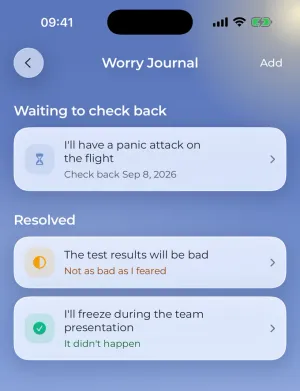
An app fixes that and should fix nothing else. It should not need an account. It should not send a record of your moods to anyone. It should not make you feel bad about the days you missed. Anxiety Tracker needs no sign-up; the diary is a file on your phone with a copy in your own iCloud Drive, and the worry journal, the breathing exercises and the crisis lines for your country sit beside it, free.
Answers
Questions people ask.
Mood diary, mood journal or mood tracker: which is it?
The same thing under three names. Diary and journal are the record itself, one mark a day. Tracker is the tool that keeps it and turns it into a calendar and a chart. Anxiety Tracker is all three, next to the panic-attack record.
How often should I log?
Once a day, at the same time. Evening is the usual choice because the day is over. Twice is fine if your days come in halves. More than that and you are tracking hours, not days, and the calendar stops meaning anything.
I missed a week. Should I fill it in?
No. A mark made from memory is exactly the bias the diary exists to remove. Leave the gap. Gaps are information too: they tend to be the weeks that were either very good or very bad.
Is a mood diary for depression, or bipolar disorder?
Clinicians use mood charts in both, and in anxiety, and the diary here is a general one. It is not a diagnosis and does not try to be. If you are being treated, ask your clinician which scale they want to see; the PHQ-9 is built in and free.
And the panic attacks themselves?
They get their own record, with a time, a strength and what helped. The mood diary is the tide; the attack record is the waves. How to keep an anxiety journal